 Neel Thakkar
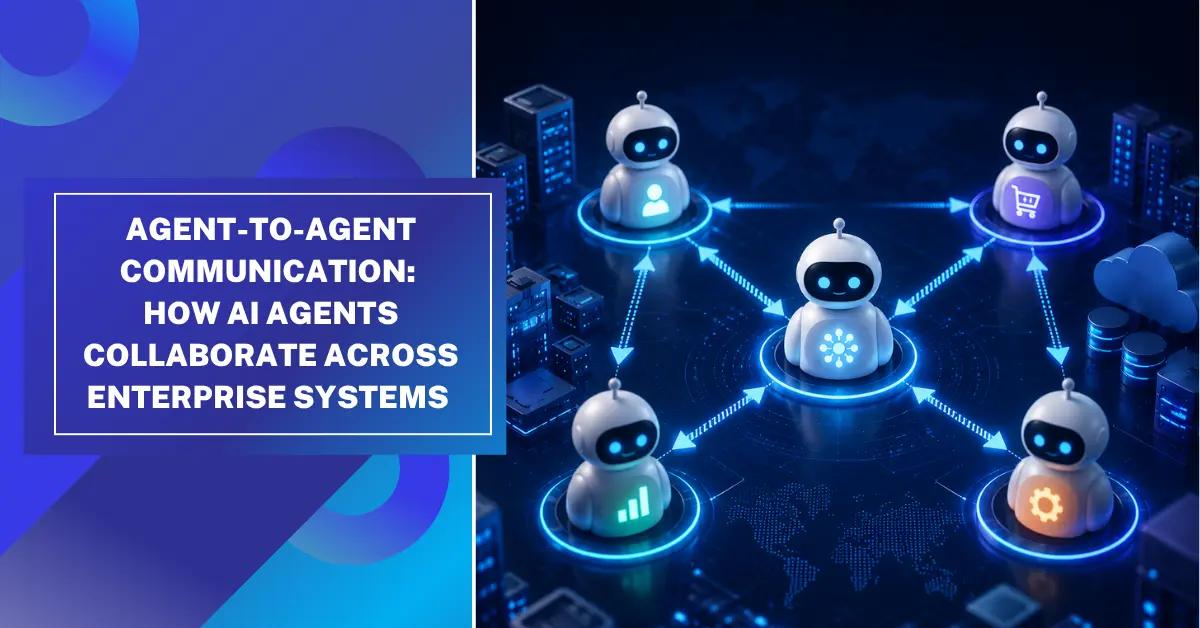
AI agents are becoming increasingly capable of handling tasks that once required constant human involvement. But as businesses adopt more specialized AI agents across sales, customer service, operations, and other functions, a new challenge is emerging: how can these agents communicate and work together? A sales agent may manage opportunities, while a service agent handles customer cases, and another agent works with orders or pricing. Each agent can be effective within its own area, but many real-world business processes span multiple functions, systems, and data sources.
This is where agent-to-agent communication becomes important. It allows AI agents to exchange information, delegate tasks, and collaborate to complete broader business objectives. The Agent2Agent (A2A) protocol is designed to support this type of interoperability by providing a standardized way for AI agents to discover, communicate, and collaborate across platforms. As enterprises explore agentic AI and multi-agent systems, understanding how agent-to-agent communication works—and how it fits into modern enterprise integration—is becoming increasingly important.
What Is Agent-to-Agent Communication?
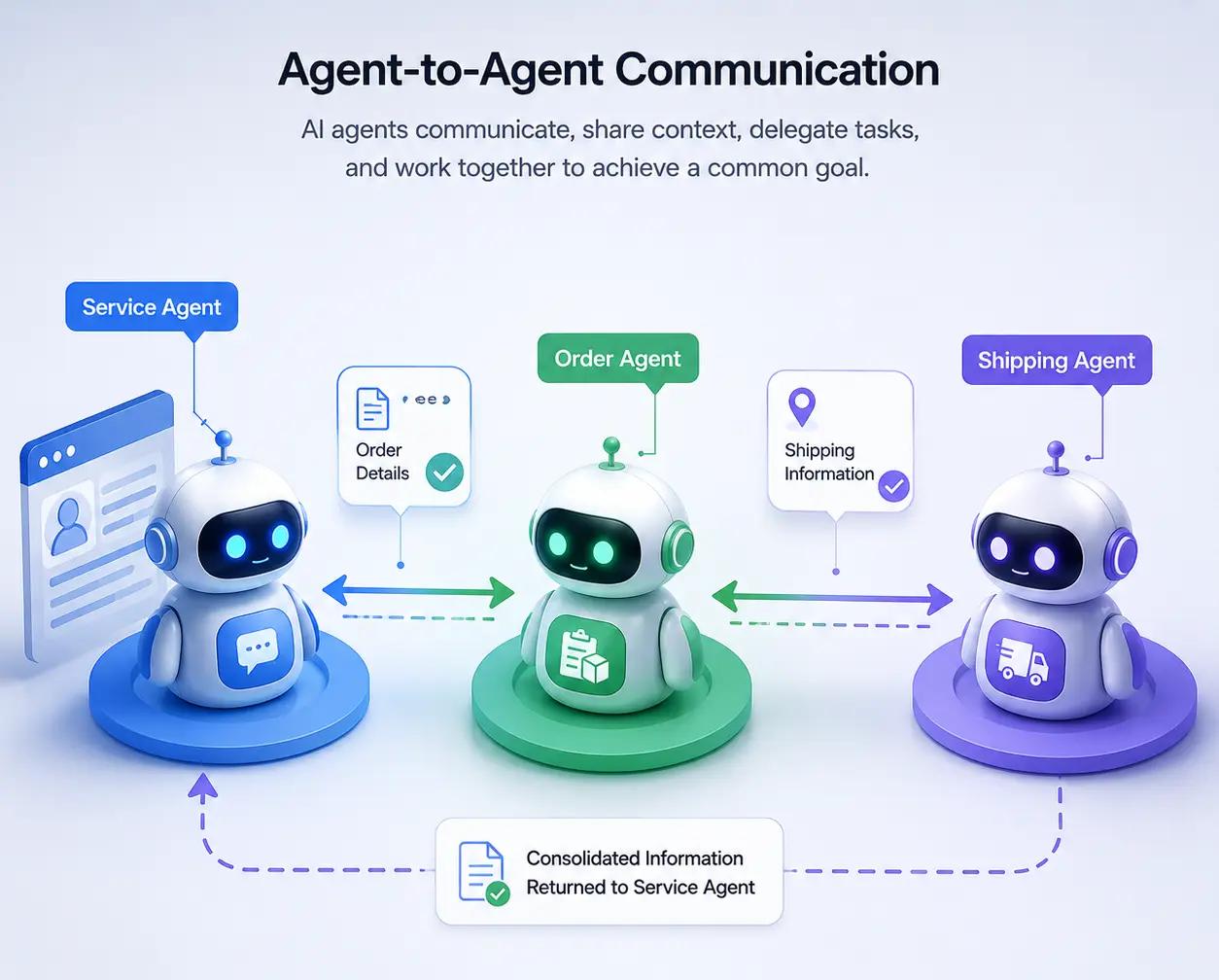
- Agent-to-agent communication allows multiple AI agents to communicate, share context, and work together to complete tasks that may be too complex for a single agent.
- Each AI agent can focus on a specific business function while collaborating with other agents when a workflow requires additional information or capabilities.
- Agents can delegate tasks to one another instead of handling every step themselves, helping create more connected and efficient AI-driven workflows.
- For example, a service agent can request order details from an order agent and then work with a shipping agent to retrieve the latest delivery information.
- This creates a connected workflow such as Service Agent → Order Agent → Shipping Agent → Service Agent, where each agent contributes to the overall task.
- Agent-to-agent communication can connect AI agents across different business functions and platforms, making it possible to coordinate workflows beyond a single application.
- The goal is to move from isolated AI agents to collaborative multi-agent systems where specialized agents can work together to achieve a broader business objective.
- AI agents can exchange relevant information and context during a workflow, helping each agent understand what has already been completed and what needs to happen next.
- Agents can respond to changing requirements by involving the right specialized agent at the right stage, rather than following a single fixed sequence for every request.
- This approach can simplify complex business processes by dividing larger tasks among specialized agents, while allowing them to work toward the same end goal.
Why Does Agent-to-Agent Communication Matter?
- Businesses are moving beyond individual AI agents and building connected networks of specialized agents that can collaborate across different functions and workflows.
- A sales agent may need information from a service or finance agent, making communication between agents important for completing end-to-end business processes.
- Agent-to-agent communication allows specialized agents to share context and delegate tasks, so each agent can contribute its capabilities to a larger workflow.
- Without a consistent communication approach, connecting multiple AI agents can require custom integrations that become difficult to maintain as the number of agents grows.
- A standardized approach to agent communication can improve interoperability across different platforms and systems, helping agents work together more efficiently.
- Connected agents can reduce the need to build every business capability into a single AI agent, allowing organizations to divide complex workflows among specialized agents.
- Agent-to-agent communication can help enterprises create more coordinated AI workflows where agents can pass information and tasks between different business functions.
- As organizations move toward multi-agent systems, agent collaboration becomes essential for building scalable and connected enterprise AI environments.
How Does Agent-to-Agent Communication Work?
- At a high level, agent-to-agent communication can be understood through three stages:
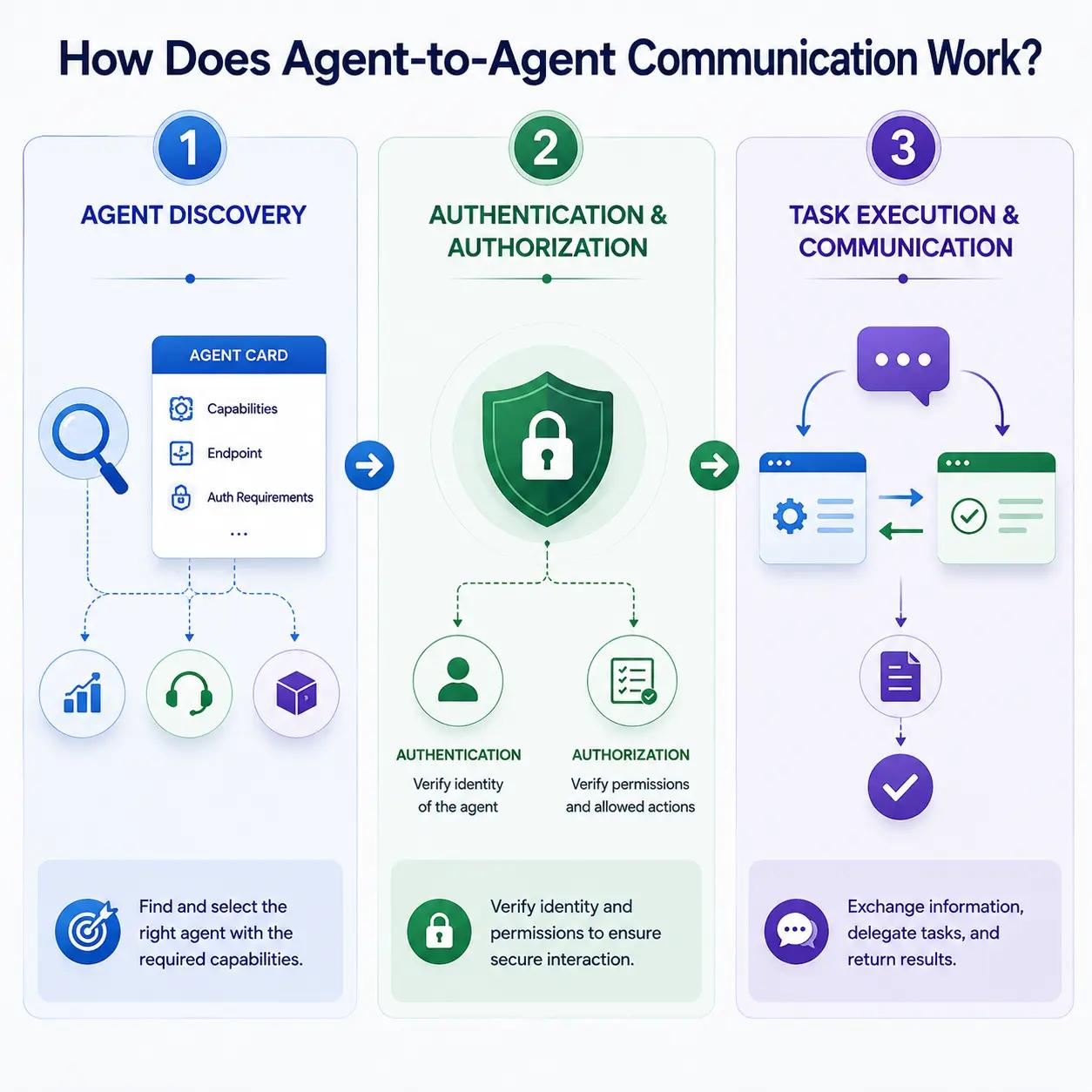
1. Agent Discovery
- The requesting agent identifies another agent with the right capabilities for the task , rather than trying to handle every requirement itself.
- An Agent Card can provide information about an agent’s capabilities,endpoint, and authentication requirements , helping other agents understand how to interact with it.
- Agents can evaluate available capabilities and select the most relevant agent for a specific request, making collaboration more targeted and efficient.
- This allows businesses to add specialized agents without giving every agent access to every capability, helping create a more modular AI architecture.
- Agent discovery can also help agents work across different platforms and environments, making interoperability an important part of multi-agent systems.
2. Authentication and Authorization
- Before sharing information or performing an action, agents need to establish identity and verify permissions , especially when sensitive enterprise data is involved.
- This helps ensure that the right agent can access the right information and perform only the actions itis authorized to perform .
- Authentication helps verify which agent is making a request, while authorization determines what that agent is allowed to access or do.
- Security controls can help protect customer data, business records, and other sensitive information as agents communicate across systems.
- Clear permissions and access policies help organizations maintain control over agent interactions , particularly when agents can perform actions on behalf of users or businesses.
3. Task Execution and Communication
- Once the appropriate agent is identified and authorized, the agents exchange messages and information to complete the requested task , with one agent potentially delegating work to another.
- A2A uses concepts such as tasks, messages, and artifacts to support structured communication and maintain relevant context throughout the interaction.
- An agent can send a request to another specialized agent and receive the required result, allowing each agent to contribute its specific capabilities.
- Tasks can involve multiple steps and interactions between agents, with information being passed between them as the workflow progresses.
- The completed result can be returned to the requesting agent, which can then use that information to continue the workflow or provide a final response.
- This structured approach allows agents to collaborate without requiring every capability to be built into a single agent, making multi-agent workflows more flexible and scalable.
Where Can Agent-to-Agent Communication Be Used?
- Agent-to-agent communication can connect different business functions , allowing specialized agents to collaborate when a task requires information or actions from multiple departments.
- In sales, an AI agent can collaborate with other agents to research accounts, qualify leads, update opportunities, and prepare relevant information before a salesperson takes the next step.
- In customer service, a service agent can work with order, billing, or shipping agents to gather information and resolve customer requests without requiring each agent to handle every task.
- In finance and operations, agents can coordinate tasks such as invoice processing, payment verification, order management, and reporting, helping connect different stages of a business workflow.
- In IT environments, one agent can identify an issue while another agent investigates the underlying problem or retrieves system information , allowing specialized agents to contribute to resolution.
- Agent collaboration can also support workflows that span multiple enterprise platforms, enabling agents to exchange relevant information even when the underlying systems have different responsibilities.
- The biggest opportunity comes when several specialized agents work together toward one business outcome, rather than operating as separate AI assistants.
- As enterprises adopt more AI agents, these collaborative workflows can become an important foundation for multi-agent systems, helping organizations coordinate AI across departments and applications.
What Is the Agent2Agent (A2A) Protocol?
- The Agent2Agent (A2A) protocol is an open standard that enables AI agents to discover, communicate, and collaborate across different platforms and environments. It provides a common framework for agents to exchange information, delegate tasks, and coordinate workflows.
Agent Discovery
- A2A helps an AI agent discover other agents that can support a specific task, allowing it to find the right capability when needed.
- Agents can identify available capabilities before initiating communication , reducing the need to build every function into a single agent.
- Agent Cards provide information about an agent's capabilities and how it can be accessed, helping other agents understand its role.
- This discovery process creates a more flexible foundation for multi-agent environments, where different agents can provide specialized capabilities.
Task Delegation
- An AI agent can delegate a task to another specialized agent when it does not have the required capability to complete the task itself.
- The requesting agent can provide relevant information and context with the task, helping the receiving agent understand what is required.
- Specialized agents can handle tasks within their own areas of expertise, allowing complex workflows to be divided among multiple agents.
- Task delegation allows agents to work together toward a shared business outcome instead of operating as isolated AI systems.
Communication and Context Exchange
- A2A enables agents to exchange messages and relevant information throughout a task, supporting communication between participating agents.
- Agents can share context that helps another agent understand the purpose and requirements of a request, rather than receiving an isolated instruction.
- The responding agent can communicate progress, information, or results back to the requesting agent as the task moves forward.
- Structured communication helps maintain continuity across multi-step workflows , especially when several agents contribute to the same business process.
Secure Agent Collaboration
- A2A supports mechanisms for authenticating and securing communication between agents, which is important when enterprise information is involved.
- Organizations can establish controls around which agents can communicate and what they are permitted to access or perform.
- Security and authorization help protect customer data, business information, and other sensitive resources during agent interactions.
- These controls provide an important foundation for trusted multi-agent environments, particularly when agents operate across different platforms or organizations.
What Is an Agent Card?
- An Agent Card is a machine-readable profile that tells other AI agents what a particular agent can do and how they can communicate with it. It acts as a digital introduction for an AI agent, providing the information needed to understand its role and capabilities.
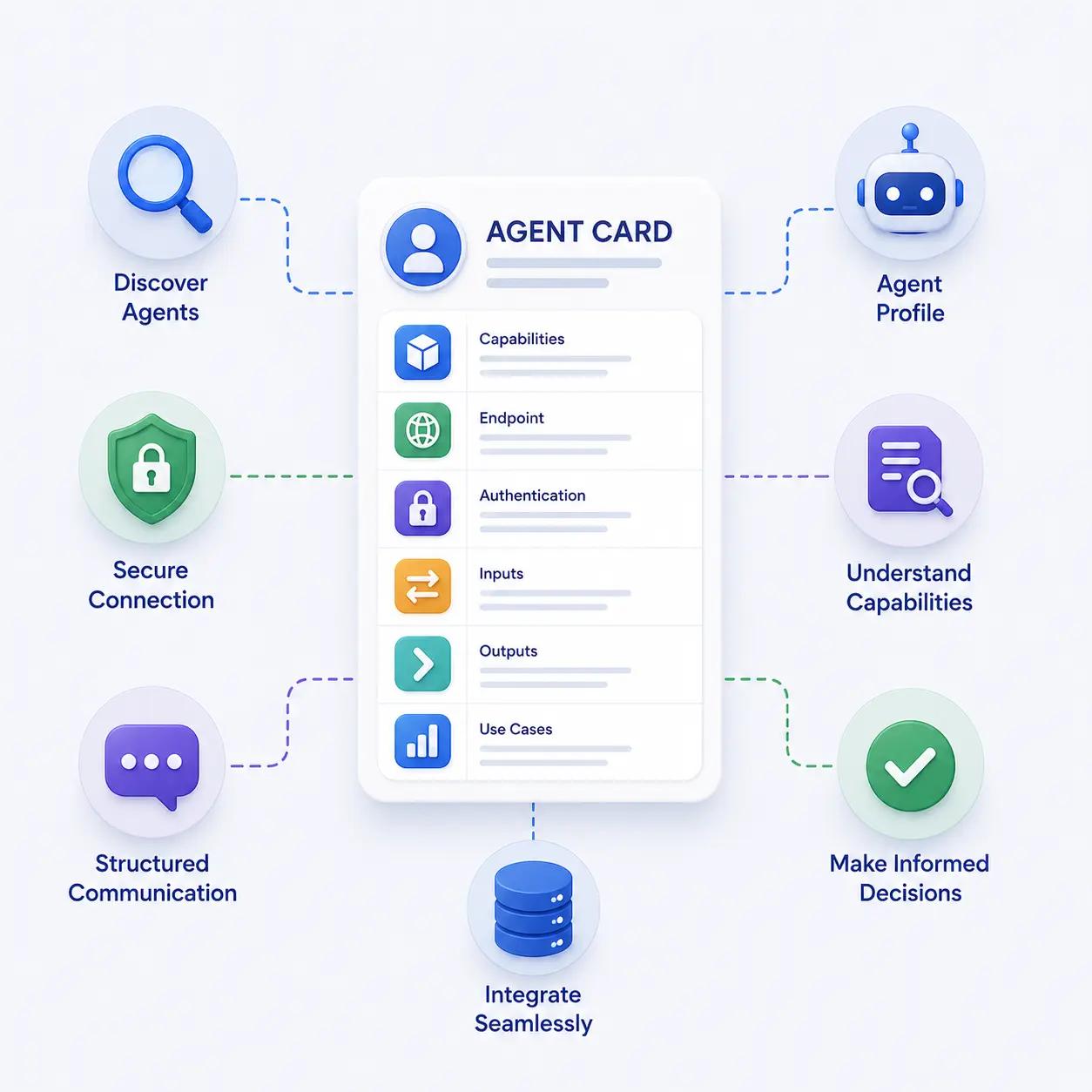
- It provides essential information about an agent’s capabilities and supported skills, helping other agents determine whether it is suitable for a specific task. This allows an agent to identify the right specialized agent without having to know its capabilities in advance.
- An Agent Card can include endpoint information and authentication requirements, giving requesting agents the details they need to establish communication. This helps agents understand where and how they can securely interact with another agent.
- It can also describe the types of inputs an agent accepts and the outputs it can provide, making interactions more predictable and structured. This information helps the requesting agent prepare the task and understand what kind of response it can expect.
- For example, a Shipping Agent may advertise capabilities such as tracking shipments, checking carrier status, and estimating delivery dates. Other agents can review these capabilities and determine whether the Shipping Agent can handle a particular delivery-related task.
- A Service Agent can use an Agent Card to discover whether the Shipping Agent has the capabilities required to handle a customer’s request. If the required capability is available, the Service Agent can communicate with the Shipping Agent and delegate the appropriate task.
- This capability-based discovery reduces the need for agents to have prior knowledge of every other agent in the environment. As more specialized agents are added, they can be discovered based on their capabilities and used when needed.
- Agent Cards playan important role in agent interoperability by helping AI agents discover, understand, and connect with other specialized agents. They provide a standardized way to describe agents and support collaboration across multi-agent environments.
How Is Salesforce Using Agent-to-Agent Communication?
- Salesforce is expanding its Agentforce strategy to help AI agents collaborate across different business functions and systems. Instead of expecting one agent to handle every task, organizations can use specialized agents that work together to complete broader workflows.
1. Agentforce and Specialized Agents
- Salesforce Agentforce allows businesses to use specialized AI agents for different business functions , including sales, customer service, operations, and more.
- Each agent can focus on a specific responsibility, giving it the capabilities and context needed for its particular role.
- When a task requires multiple capabilities, agents can collaborate instead of operating independently, helping connect different stages of a business process.
- This approach allows organizations to build multi-agent workflows where each agent contributes to a shared business objective.
2. Connecting Business Processes
- Agent-to-agent communication can help connect different stages of a customer or business workflow within the Salesforce environment.
- For example, a Service Agent can work with an Order Agent to retrieve order information when responding to a customer request.
- The Order Agent can then involve a Shipping Agent to retrieve delivery details, allowing the information to flow back to the Service Agent.
- This collaboration enables agents to contribute their specialized capabilities without requiring one agent to manage the entire process.
3. Multi-Agent Orchestration
- Salesforce can coordinate multiple specialized agents so they can contribute to a single business workflow, depending on the requirements of the task.
- A workflow could involve a Service Agent → Order Agent → Shipping Agent → Service Agent sequence to resolve a customer request.
- Each agent can handle the part of the workflow that matches its capabilities while passing relevant information to the next agent.
- This approach can make complex AI-driven processes more modular, connected, and easier to scale as organizations introduce additional agents.
4. Working With External Agents
- Agent-to-agent communication can also extend AI collaboration beyond Salesforce, allowing Salesforce-based agents to interact with agents operating in other environments.
- This can be valuable when a business relies on external systems for functions such as logistics, payments, analytics, or specialized services.
- A2A provides a standardized approach for communication between compatible agents, reducing the need to create a completely different interaction model for every agent.
- This can help organizations build a more connected enterprise AI ecosystem across Salesforce and other platforms.
What Is the Difference Between A2A and MCP?
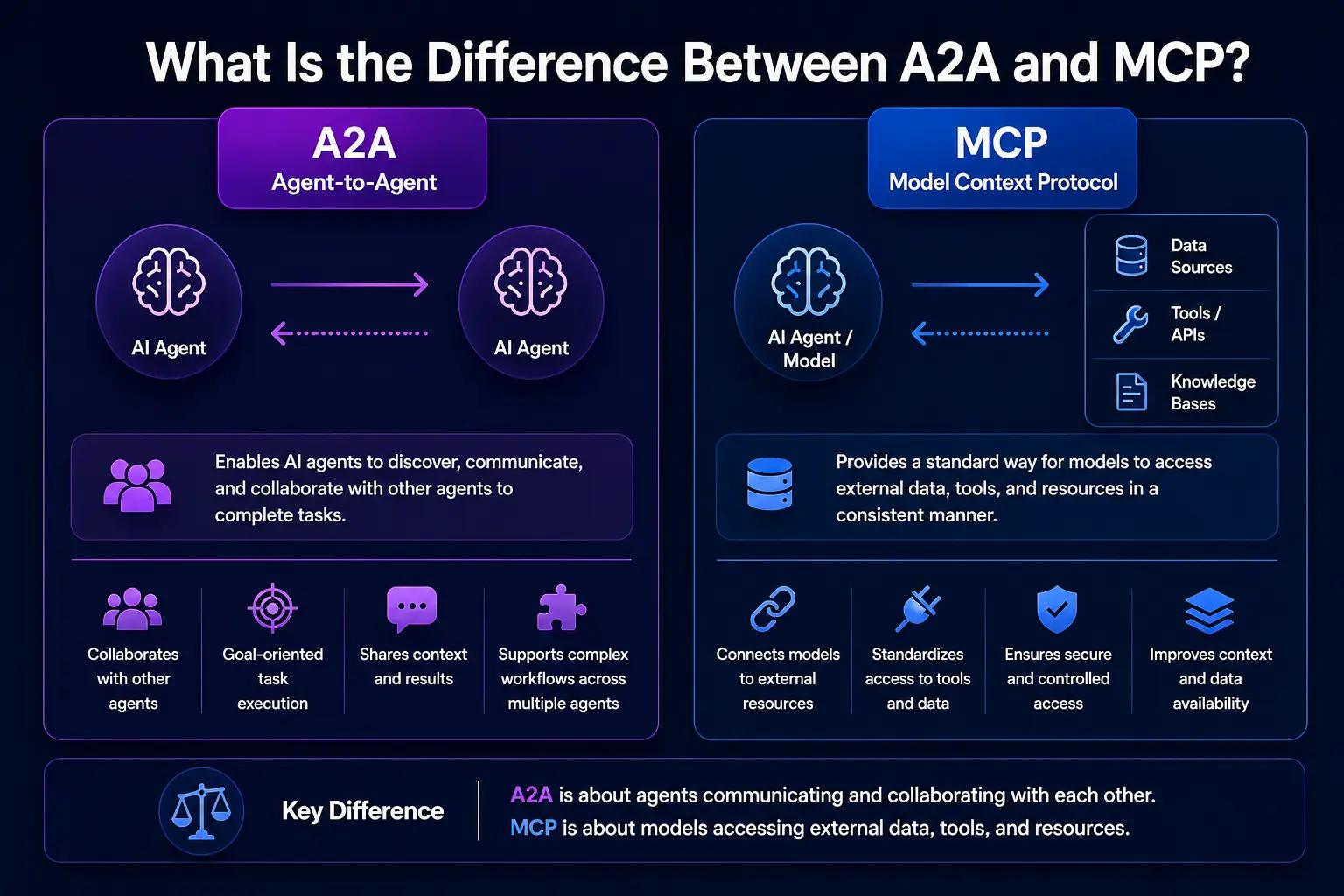
- A2A and MCP both support interoperability in agentic AI, but they address different communication requirements. Understanding the distinction helps businesses choose the right approach when designing AI architectures.
- A2A focuses on communication and collaboration between AI agents, allowing agents to discover capabilities, exchange context, delegate tasks, and work together toward a shared objective.
- MCP focuses on connecting AI applications and agents with external tools, data, and services, giving them a standardized way to access capabilities they need to perform tasks.
- A simple way to remember the difference is: MCP connects AI with tools and data, while A2A connects AI agents with other AI agents. The two protocols therefore operate at different levels of an AI ecosystem.
- An AI agent can use MCP to access information or functionality from an external system, such as retrieving data from Salesforce or interacting with an enterprise application.
- The same agent can use A2A to collaborate with another specialized agent, allowing it to delegate a task or request a capability that another agent provides.
- A2A and MCP are not competing technologies and can work together within the same AI architecture. One can support agent collaboration while the other provides access to the tools and data those agents need.
- Together, A2A and MCP can support more connected enterprise AI environments, where agents collaborate with one another while also accessing the systems, data, and tools required to complete business workflows.
Benefits of Agent-to-Agent Communication for Businesses
1. Specialized AI Agents
- Agents can be designed around specific business processes, such as sales, customer service, finance, or operations.
- Each agent can focus on the data and tasks relevant to its role, rather than managing unrelated responsibilities.
- Specialized agents can collaborate when a workflow requires multiple capabilities, allowing businesses to divide complex tasks.
- This approach can make AI environments more modular, making it easier to introduce or update individual agents.
2. Better Agent Interoperability
- Agents can communicate with other compatible agents without requiring every interaction to follow a completely different approach.
- Organizations can connect specialized agents across different business and technology environments, supporting broader AI collaboration.
- Improved interoperability can reduce limitations caused by isolated AI systems, helping agents work together more effectively.
- A common communication framework can provide a stronger foundation for expanding multi-agent environments as new agents are introduced.
3. Task Delegation
- One agent canidentify a task that requires another agent’sexpertise and delegate that specific work.
- The receiving agent can focus on completing the task within its specialized area, while the requesting agent continues coordinating the workflow.
- Delegating tasks can prevent individual agents from becoming overloaded with too many responsibilities.
- This allows multiple agents to contribute to complex workflows while working toward the same business outcome.
4. More Connected AI Workflows
- A sales workflow could involve Lead Qualification → Account Research → Sales Outreach → Opportunity Management, with different agents supporting each stage.
- Agents can pass relevant information and context between workflow stages, helping maintain continuity throughout the process.
- Connected workflows can bring together capabilities from multiple business functions, creating a more coordinated AI experience.
- This approach can help businesses move from individual AI use cases toward broader end-to-end automation.
5. Reduced Dependence on Point-to-Point Connections
- A common communication approach can reduce the complexity of connecting multiple compatible agents.
- Organizations can expand their agent ecosystem without designing an entirely new communication model for every interaction.
- Consistent communication patterns can make multi-agent environments easier to manage as the number of agents grows.
- This can support a more scalable architecture for businesses planning long-term AI adoption.
6. Greater Potential for Enterprise Automation
- Agents can coordinate multiple steps of a business process, reducing the need for manual intervention at every stage.
- Complex workflows can be divided among specialized agents, allowing each agent to handle the tasks it is best suited for.
- Agent collaboration can connect processes across departments and enterprise applications, creating broader automation opportunities.
- This can help organizations build AI-driven workflows that are more connected, scalable, and adaptable as business needs evolve.
Challenges of Agent-to-Agent Communication
- Security becomes more complex when multiple AI agents can communicate and take actions across business systems, making identity, authentication, authorization, and data access important considerations.
- Organizations need to know which agent is making a request, on whose behalf, and what that agentis authorized to access or perform , particularly when sensitive enterprise data is involved.
- Maintaining trust between agents can become challenging when agents operate across different platforms, applications, or organizations , making consistent security and verification mechanisms essential.
- Observability can become more difficult as multiple agentsparticipate in the same workflow , especially when teams need to understand how a task moved from one agent to another.
- Organizations need visibility into agent interactions, including which agent initiated a task, what information was exchanged, and what actions were performed , to effectively monitor multi-agent workflows.
- Troubleshooting can become more complicated when a workflow involves several interconnected agents, making detailed logs and traceability important for identifying where an issue occurred.
- Governance is essential for defining what agents can access, which actions they can perform, and when human approval isrequired , particularly for high-impact business processes.
- As AI agents become more autonomous, organizations need clear policies for monitoring, auditing, and controlling agent interactions, making governance a core part of the overall agent architecture.
How Can Businesses Prepare for Agent-to-Agent Communication?
Businesses can prepare for multi-agent environments by identifying the right use cases, defining agent responsibilities, planning interoperability, andestablishing security and governance from the beginning.
Identify Repetitive Business Processes
- Start byidentifying repetitive workflows that involve multiple teams, systems, or decision points , as these can provide strong opportunities for agent collaboration.
- Look for processes that require frequent information exchange or manual handoffs between employees, applications, or departments.
- Prioritize workflows where multiple specialized capabilities are alreadyrequired , making them suitable for collaboration between AI agents.
- Evaluate the potential business impact of automating each process, including efficiency, response time, and customer experience.
Define Agent Responsibilities
- Clearly define what each AI agent is responsiblefor and which business processes or tasks fall within its capabilities.
- Assign specialized tasks to agents based on theirexpertise, data access, and available actions , rather than giving every agent the same responsibilities.
- Determine when an agent should complete a task itself and when it should delegate the task to another agent.
- Establish clear boundaries between agents to reduce overlapping responsibilities and make multi-agent workflows easier to manage.
Evaluate Interoperability Requirements
- Determine which agents need to communicate across Salesforce, enterprise applications, external platforms, or third-party AI systems.
- Identify the data, capabilities, and business functions that need to move between agents during a particular workflow.
- Consider whether standardized protocols such as A2A can support the required agent-to-agent interactions across different environments.
- Plan for future interoperability as more agents and platforms are introduced, rather than designing an architecture only for current requirements.
Establish Security and Governance
- Define how agents will be authenticated, authorized, andmonitored before allowing them to communicate or perform business actions.
- Determine which agents can access specificdata and which actions requireadditional permissions or human approval.
- Establish policies for auditing agent interactions, tracking actions, andmaintaining visibility across multi-agent workflows.
- Build security and governance into the architecture from the beginning, rather than treating them as considerations after deployment.
Consider Complementary Technologies
- Understand how A2A and MCP address different interoperability requirements within an agentic AI architecture.
- A2A can support communication and collaboration between AI agents, while MCP can help AI applications and agents connect with tools, data, and services.
- Evaluate where these technologies can work together within your business workflows to support agent collaboration and access to enterprise capabilities.
- Choosing the right combination of technologies can help organizations build a more connected, flexible, and scalable AI architecture.
Conclusion
Agent-to-agent communication is changing how businesses approach enterprise AI. Instead of relying on a single AI agent, organizations can connect specialized agents to share context, delegate tasks, and collaborate across business processes using approaches such as A2A.
For Salesforce and other enterprise environments, this creates opportunities for more connected, scalable, and intelligent AI workflows. As agentic AI continues to evolve, businesses can prepare by focusing on interoperability, security, governance, and effective collaboration between agents.